


Why Jamdani Sarees Are the Perfect Choice for Festive Dressing

The Saree Made of "Woven Air"
In the imperial courts of the Mughal empire, emperors famously christened it Baft-Hawa—"woven air." To hold a true handloom Jamdani is to witness a profound structural paradox: a garment engineered to be completely weightless, yet intricately dense with floating geometry. It carries no prints and features zero post-loom embroidery. Instead, it is a masterclass in pure architectural weaving involving elaborate 16-step weaving process, where motifs seem to materialize magically inside a gossamer matrix of fine cotton muslin.
Far from a dusty heirloom, the Jamdani saree is a living archive of human mathematics, geographical alchemy, and enduring festive romance. Whether you are navigating the electric crowd of a Maha Ashtami night pandal or stepping into a high-fashion evening gallery, this is your single-source guide to understanding, decoding, authenticating, and styling the absolute pinnacle of Indian textile design.
Section 1: The Alchemy of the Delta
The Origin: A Royal Legacy
The story of Jamdani began around 12th century, evolving from an elite luxury reserved strictly for royalty. Mughal emperors like Jahangir had been portrayed, draped in Jamdani sash known as Patka and the Jamdani #kaarigari found a great place in the royal wardrobes. The Nawabs of Bengal region also patronised its master weavers recognizing the prevalence & popularity of this craft. It quickly became an object of global desire, symbolising the pinnacle of wealth and refined taste.
The Bengal Roots: A Geographical Miracle

This historic craft flourished specifically in Bengal due to a unique geographical miracle. The microclimate of the Shitalakhya River basin (in modern-day Bangladesh) provided the exact high humidity needed to spin ultra-fine, high-count cotton threads without them snapping on the loom. Furthermore, the unique mineral composition of the river water gave the local yarn its legendary, translucent sheen. Over time, West Bengal hubs like Phulia and Shantipur adapted these techniques, cementing the region as the global epicentre of fine muslin.
The Evolution: Colonial Survival
The art form faced near-extinction during British colonial rule. The influx of cheap, machine-made British cotton imports flooded local markets, while harsh colonial trade policies actively dismantled the handloom industry, forcing generational weavers off their looms.
The Global Shield: UNESCO Protection
Jamdani's journey into the modern era is a triumph of cultural resurrection. Today, its profound historical and artistic weight is globally safeguarded under its UNESCO Intangible Cultural Heritage status. This prestigious accreditation acts as a protective shield, elevating the craft to a global treasure and ensuring the survival of artisan families against the tide of fast fashion.
Section 2: The Art of Living Math
The Paperless Art of the Rhythmic Spoken Code
Step into a traditional Jamdani workshop, and you will not find paper blueprints or digital screens. Many Master weavers create breathtakingly complex geometric patterns entirely from memory. They rely on their generational skill & cognitive chunking of the weave pattern inside their mind, sometimes reciting orally while they weave. The Master weaver speaks the formula aloud, and the second weaver instantly translates the same into precise thread placements, all without any paper or written down graphs. At every few inches of created saree, they stop to apply starch. The overall process looks like a stunning symphony of mathematics, cognition, and textile art played out in real time.
Did you know a motif rich Jamdani may take up to one year to complete
The Weave: The Floating Supplementary Weft
The sheer magic of Jamdani lies in its structural illusion. Unlike standard sarees where patterns are stamped on or embroidered later, Jamdani motifs are embedded directly into the fabric as it is built on the loom. Using fine bamboo sticks or horn needles, the weaver manually interlacing thicker decorative threads—known as the supplementary weft—into the translucent base warp. The result? Intricate motifs that appear to float seamlessly on a cloud of muslin, looking identical on both the front and the reverse.

What Sets Jamdani Apart
Jamdani motifs are made with a discontinuous supplementary weft. Separate threads are worked in by hand only where each motif appears, rather than running across the full width of the cloth. The result is festive detail without heavy zari or stones.
Jamdani weaving is all about finesse & intricacy
The "Hajar Buti Jamdani" which translates to "A Thousand motifs in Every Saree," is among the most famous variations of the craft. Intricately filled with lush floral patterns, it offers a stunning visual experience and serves as a testament to the artisan's unyielding passion and skill.
Section 3: Deciphering the Threads
The Visual Dictionary: Reading the Fabric
A Jamdani saree is never just an abstract pattern; it is a visual storybook written in thread. For centuries, weavers have used the loom to mirror the world around them, transforming everyday elements into highly stylized, geometric art. To wear a Jamdani is to wear a canvas of regional folklore, where every single line and curve holds a distinct cultural meaning.
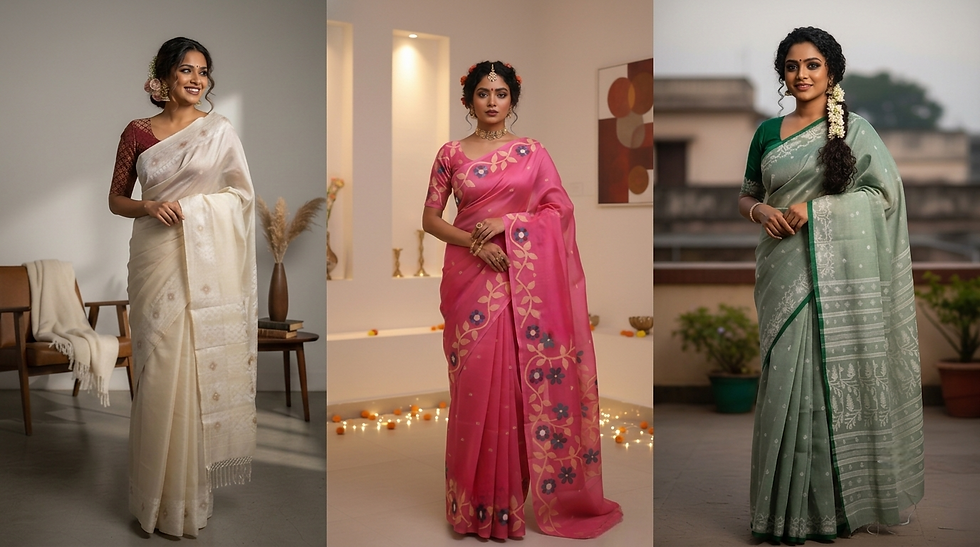
The Motifs and Their Meanings
Panna Hazar (Thousand Emeralds): The ultimate royal layout. The entire body of the saree is adorned with thousands of tiny, shimmering floral sprays, designed to evoke the opulence of an eternal, jewel-toned Mughal garden.
Kalka (The Paisley): A timeless classic across the subcontinent. In Bengal, this twisting, mango-shaped motif symbolizes the flame of life, fertility, and cosmic continuity.
Dubli Jal (The Floral Network): A highly intricate web pattern inspired by a dense canopy of marigolds. It represents protection, prosperity, and the interconnectedness of nature.
Dhaniya Chhi (Coriander Seed): A beautiful example of rural artistry. Instead of grand royal icons, this minimalist, repeating dot pattern elevates simple, daily kitchen ingredients into high-fashion luxury textures.
There are many more prevalent motifs & patterns which have different names according to their appearance, like - butidar, tersa, jalar, duria, charkona, mayur pyanch, kalmilata, puilata, kachupata, katihar, angurlata, sandesh paar, prajapati paar, shaplaful, baghnali, juibuti, chandra paar, chandrahar, hansa, jhumka, kachupata paar, badghat paar, kalasful, murali jal, mihin paar, kankra paar, shamukbuti, prajapati buti, belpata paar, jabaful.
Section 4: The Jamdani Spectrum
The Big Three: Regional Varieties Popular Today
While the core technique remains the same, regional variations alter the drape, weight, and texture completely:
Dhakai Jamdani: The absolute gold standard from Bangladesh. Known for its ultra-fine, translucent cotton base and legendary prestige, it offers the closest experience to the historic "woven air."
Tangail Jamdani: Hailing from the Tangail district, these feature highly packed, crisper motifs and distinct, heavily detailed borders that give the saree a structured silhouette.
Phulia and Shantipur Jamdani: The West Bengal counterparts. Famous for integrating soft, contemporary cotton-silk and resham blends, making them incredibly lightweight, comfortable, and easy to drape for modern wear.
The Crown Jewel of Durga Puja

Durga Puja dressing draws on many Bengal textiles, including Tant, Garad, Korial and Baluchari. Jamdani stands out for woven craftsmanship that stays understated and it moves easily between occasions. Jamdani has firmly cemented itself as the hot favorite for Durga Puja and autumn festivities.
The reason is a brilliant mix of seasonal logic and aesthetic grandeur. Festive days in Bengal are long, warm, and highly humid. The feather-light, breathable handloom weave ensures the wearer stays completely cool while pandal-hopping during the day. Concurrently, its sheer elegance matches the royal opulence required for grand evening gatherings, making it the definitive choice for Maha Ashtami night.
The Cross-Cultural Evolution
Shattering the myth that it belongs solely to Bengali culture, the Jamdani has transitioned into a global minimalist luxury statement. Its understated elegance and weightless drape have made it immensely popular among South Indian communities, high-profile corporate minimalists across India, and international fashion runways. It is favored by modern dressers who demand regal heritage clothing without the suffocating weight of heavy silks.
Section 5: The Buyer’s Playbook
The Powerloom Threat: Navigating the Counterfeit Market
As Jamdani's global popularity surges, the market has been flooded with cheaper, mass-produced machine imitations. These polyester-heavy powerloom variants look convincing from a distance but lack the breathability, weightless comfort, and artistic value of a true handloom creation. To protect your investment, you need a foolproof way to verify authenticity.
The 5-Step Diagnostic Process

Step 1: The Reverse Peek (The Ultimate Test): Turn the saree over and inspect the back of the motifs. On an authentic handloom Jamdani, the supplementary weft threads are meticulously locked and tucked into the fabric by hand, leaving a neat, nearly seamless reverse side. Powerloom fakes feature messy, loose machine-cut threads or long "floats" hanging off the back.
Step 2: The Weight and Softness Check: True handwoven cotton Jamdani is weightless, airy, and grows softer with every touch. Synthetic replicas feel stiff, heavy, or scratchy against the skin due to the use of cheap polyester blends.
Step 3: The Human Touch Imperfection: Inspect the repeating motifs closely. A machine print or powerloom weave produces mathematically identical, flawless patterns. A genuine handwoven piece will always carry tiny, charming human variations in thread tension, proving it was crafted by an artisan, not programmed by a computer.
Step 4: The Transparency Gradient: Hold the fabric up to the light. An authentic Jamdani displays a stark, beautiful contrast between the sheer transparency of the base fabric and the opaque, dense thickness of the hand-woven motifs. Fakes look uniform and lack this signature optical illusion.
Step 5: The Material and Price Alignment: Pure cotton or high-grade resham (silk-blend) Jamdanis require weeks of intense manual labor, and their pricing reflects that craftsmanship.
Section 6: The Modern Festive Lookbook
The Contemporary Palette: Festive Color Trends

While the traditional ivory-and-red combination remains an eternal classic, modern festive styling demands a departure from the predictable. The current trend centers on monochromatic pastels—think muted lavender, mint green, and powder blue woven with matte gold or copper zari for an ethereal daytime look. For evening wear, opt for high-contrast drama: a stark, opaque night-sky black or deep royal blue adorned with sharp silver motifs creates a striking silhouette under festive lighting.
Colour Shapes Motif Visibility
Because the design is woven directly into the fabric, colour does more than set the mood—it defines how clearly the pattern emerges and how the motifs layer visually.
Subtle Tones: Close shades between the base and motif translate as rich texture, revealing intricate details upon closer look in daylight.
Bold Contrasts: High-contrast combinations carry across a pandal and pop in photographs. The timeless Bengali pairing of red and white maximizes this visibility, as seen in our red and white collection.
Pale Palette: Lighter shades create an embossed, sculptural motif effect when woven with low-contrast supplementary threads.
Family customs around festive colours vary, so we recommend following the traditions observed in your household.
The Trad-Modern Silhouette: Innovative Styling Tips
To elevate your Jamdani into a high-fashion statement, move past the standard matching round-neck blouse. Pair the sheer, airy drape of the saree with structured, modern separates to create a compelling visual balance:
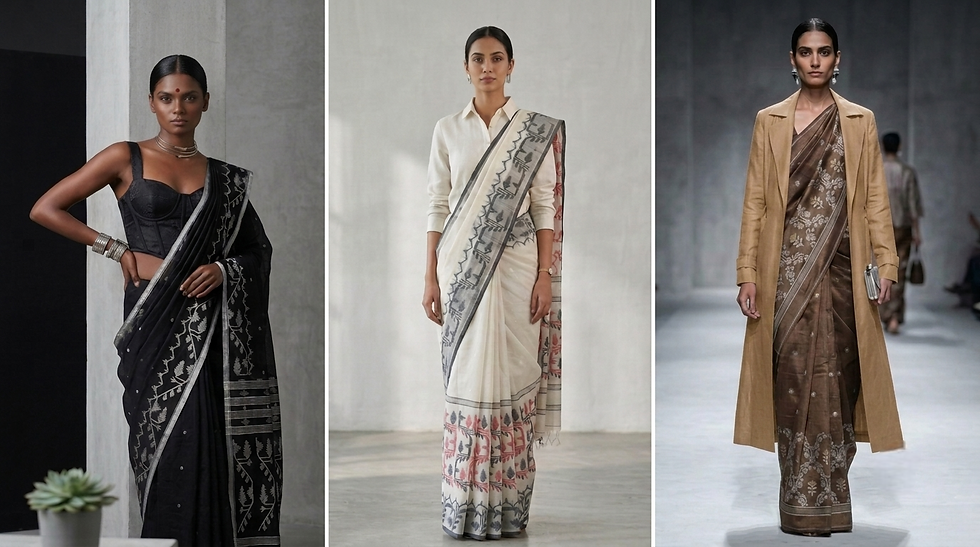
The Tailored Shirt: A crisp, collared linen or raw silk button-down shirt tucked under a neat nivi drape.
The Cropped Corset: A structured silk or brocade corset blouse that introduces sharp lines beneath the gossamer fabric.
The Modern Overlay: A long, sleeveless sheer vest or a tailored lightweight trench coat layered over the saree for a sophisticated, runway-ready look.
The Finishing Touches: Accessories and Beauty
The Jewelry: Heavy, traditional gold jewelry can visually weigh down the delicate texture of a Jamdani. Instead, lean into the minimalist luxury aesthetic by accessorizing with oxidized silver statement chokers, sleek bohemian fabric jewelry, or multi-layered baroque pearls.
The Makeup: Keep the base dewy, clean, and minimal to mirror the light, breezy nature of the fabric. Anchor the look with one strong focal point—either a bold, classic crimson lip or a sharp, oversized matte red bindi.
Caring for Your Jamdani Saree
Caring for your beloved Jamdani saree is not so difficult. If you follow the care label or the Product’s instructions for your saree’s maintenance tips, you can be assured to preserve its beauty for a very long time. In general, follow the below cleaning guidelines to ensure proper handling:
Gentle Wash: Gently swirl in cold water with a mild liquid soap or baby shampoo. Never soak, scrub, or wring.
Air Dry Flat: Gently squeeze out excess water, then lay flat on a towel in the shade.
Safe Ironing: Iron on low heat using steam, or place a thin cotton cloth on top to protect the motifs.
Breathable Storage: Wrap in a cotton or muslin cloth instead of plastic to keep the fabric fresh.
Rotate the Folds: Every few months, unfold, air it out, and refold along new lines to prevent permanent creases
When is doubt, dry cleaning is the best option
Wearable Art for the Future
A genuine Jamdani is not just a seasonal wardrobe addition; it is a piece of cultural resilience you can wear. When you choose an authentic handwoven saree over a mass-produced machine copy, you are actively investing in the survival of an ancient lineage of master artisans. You carry forward a story that began in the humid river basin of old Bengal, survived empires, and continues to redefine modern luxury—one floating thread at a time.
Timeless Jamdani Collection from The Loom Studio
The beauty of a Jamdani saree lies in the way feather-light comfort and refined sophistication come together. It can embrace a formal ritual, light up an intimate evening, or simply make a casual affair feel extraordinary. The right choice balances the occasion with the richness of the motif, the breathable feel of the cotton or silk-cotton weave, and the love it requires to last for generations.
Explore The Jamdani Edit collection to discover the sarees that bring together the excellence of Indian textile traditions and contemporary festive dressing. Choose a saree that feels right for the celebration today—and one you will look forward to wearing again.
At The Loom Studio, our Jamdani collection sarees are a testament of generational kaarigari for the Festive season. Explore are full range of festive sarees in The Utsav Collection
Frequently Asked Questions
1. How do I decide between Jamdani and Tant, Garad or Baluchari for puja?
Think about the effect you want. Jamdani offers woven floral detail in a fine structure. Garad and Korial lean towards a more traditional ritual look. Baluchari is known for large narrative pallu motifs. Many people keep one of each for different days.
2. How do I judge a Jamdani online when I cannot feel the fabric?
Check the fibre composition, weave description and saree length. Then ask for close up photos or videos of the body, border and pallu. Our team can share these on request.
3. What should I do if a thread snags on puja day?
Do not pull or cut it. Gently ease the loop back along the weave from the reverse with a fine needle. For anything larger, take it to a skilled repairer.
4. How can I shop at The Loom Studio and get help choosing?
Browse the Jamdani collection and filter by fabric, colour and price. For guidance, write to cs@theloomstudiolifestyle.com or message us on WhatsApp at +91 93535 85386.
5. What if the saree is not what I expected on arrival?
Review our return and exchange policy for current terms and contact our support team as soon as you receive the order.
To display the Widget on your site, open Blogs Products Upsell Settings Panel, then open the Dashboard & add Products to your Blog Posts. Within the Editor you will only see a preview of the Widget, the associated Products for this Post will display on your Live Site.
Start your 14 days Free Trial to activate products for more than one post.
icon above or open Settings panel.
Please click on the


.jpg)
%20(500%20%C3%97%20500px).jpg)


Comments