


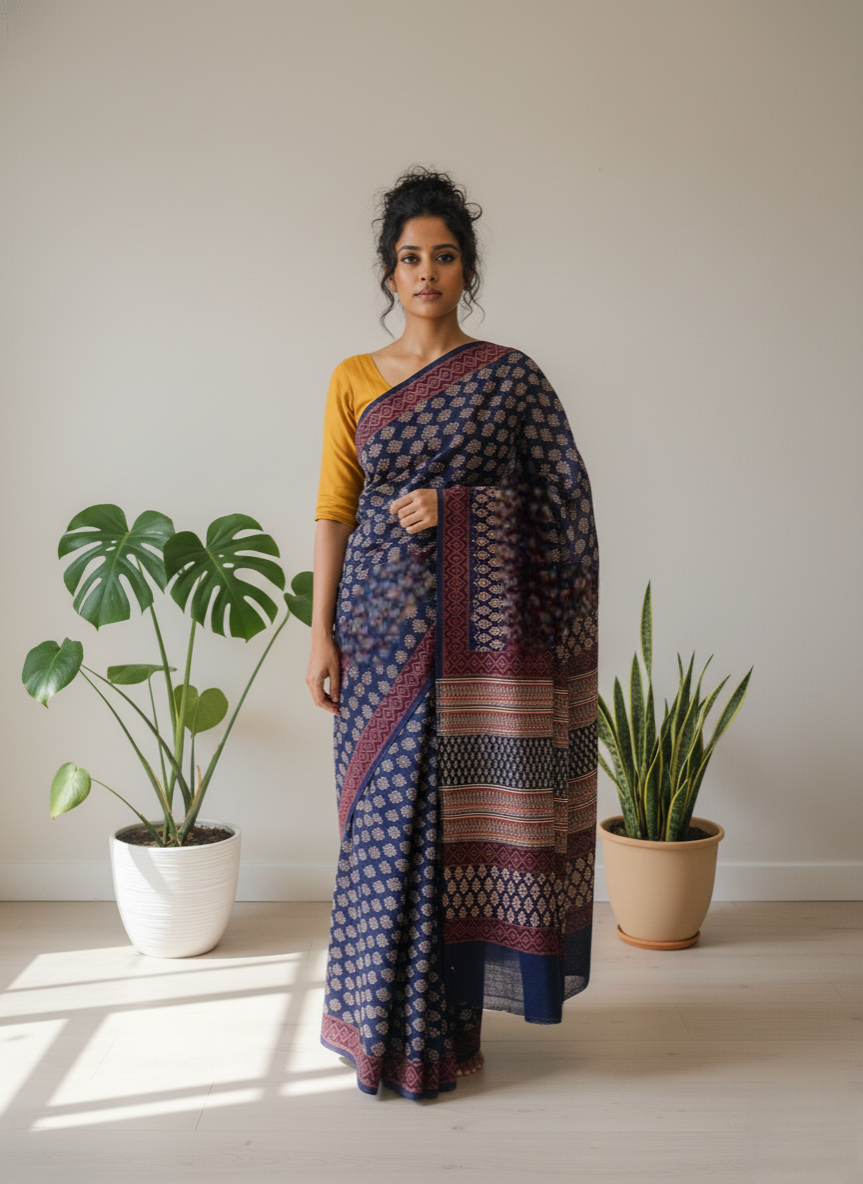


History of Traditional Ajrakh Silk Sarees & Dresses in India dates back ages
‘Ajrakh’ is a special hand-block printing technique dating as long back as the Indus Valley Civilization and has its roots in the Kutch, Barmer and Sindh region. The word 'Ajrakh' means 'keep today' in Arabic — reflecting its timeless quality. The artform is a unique, naturally environment-friendly and painstaking craft which uses natural dyes, special treatment steps and iterative printing, dyeing and washing process before acquiring its final poise. Today, Ajrakh is one of India's fastest growing saree crafts, gaining ground globally on the back of the slow fashion movement, rising demand from conscious buyers and continued support from leading fashion designers.
Why an Ajrakh Modal Silk Saree Should Have a Place in Your Wardrobe
From hand-carved blocks and intricate resist printing to layered natural dyes, washing, drying, and repeated printing, every Ajrakh saree is a testament to painstaking craftsmanship and generations-old artistry.
The story of Ajrakh does not end once the fabric leaves the dye vat. It continues in how the saree feels when you actually wear it. A modal silk Ajrakh saree carries the raw, earthen character of the block print, but in a fabric that feels light and drapes with a certain fluid ease. That contrast between rustic pattern and natural softness is what gives it a quiet, effortless luxury, the kind that reads as a style statement without trying too hard.
Whether in silk, modal silk or cotton, Ajrakh remains a strong choice for festive wear too, especially when the piece is purely hand blocked. That craftsmanship is exactly why hand blocked Ajrakh tends to carry a premium price and holds its appeal well beyond everyday styling.
If you are looking to buy an Ajrakh silk saree online in India, or kaftan for something more relaxed, The Loom Studio is your place to start. Our Ajrakh collection sits within a wider handcrafted range, and the 'Ajrakh Royale' line in particular celebrates the revival of this timeless hand block printing craft, shaped by the work of our Kaarigari .
The range spans sarees, kaftans and skirts, each bringing a bit of traditional elegance into everyday wear. Explore the collection to see what fits your wardrobe.
